
Top Signs You Need Air Duct Cleaning Service – Don’t Ignore These
Most homeowners wait until something breaks before they think about their ducts. Air doesn’t break. It just gets dirtier, slowly, until the dust on your registers stops being a minor annoyance and starts being a clue. The signs that actually matter in Knoxville aren’t vague either – they tend to point to a specific part of your system, which means you can describe the problem accurately and get the right service instead of a generic vacuum job. Here’s what to look for, and what each sign usually means.
If you’d rather skip the detective work and have someone look at the system directly, call (888) 881-9239. We answer 24/7, fast dispatch from 7am to 7pm, Sunday through Friday.
Our technicians have up to 10 years of experience reading exactly these signals, and we’ve learned that the difference between “needs cleaning” and “needs repair first” changes the whole conversation.
What are the clearest signs your ducts need cleaning?
The strongest signs are visible debris blowing out of supply registers, a musty smell that appears only when the fan runs, dust that comes back within days of cleaning, and a system that cycles more often than it used to. Those four point at contamination inside the ductwork itself. Anything else is a guess.
Here’s the fuller list we walk homeowners through, roughly in order of how often each one turns out to be real:
- Debris at the registers. A thin film is normal. Puffs of dust or visible particles when the system kicks on are not.
- Musty odor tied to the fan. If the smell shows up when the blower starts and fades when it stops, the contamination is somewhere in the air pathway, not in the room.
- Dust returning fast. Surfaces that get dusty again within a week or two after you clean them suggest the system is redistributing what it collects.
- Uneven airflow room to room. Weak registers on one side of the house often mean a restriction or a disconnected run.
- Recent pest activity. Rodents and insects leave droppings and nesting material inside duct runs, and that calls for more than a standard clean.
- Black streaking around supply vents. That staining is often filtration bypass – air moving around the register instead of through the filter.
Notice that none of these require you to guess at the scale of the problem. Each one gives a technician a starting point.
Which signs mean coil or air handler cleaning is the real priority?
Some symptoms look like dirty ducts but actually point to the coil or the air handler. If your system runs longer than it used to, cooling feels weak, or the smell is strongest near the indoor unit, the ductwork may be fine and the wet components may be the problem.
A dirty evaporator coil insulates itself. Refrigerant still cycles, the compressor still runs, but the coil can’t pull heat out of the air the way it should. The system compensates by running longer, and a longer run means more moisture pulled out of Knoxville’s humid summer air, which means a wetter coil, which means more buildup. It’s a loop. Cleaning the ducts in that situation helps, but it doesn’t break the loop.
The same goes for the air handler cabinet and the blower wheel. A blower caked with dust moves less air, and less air means every duct in the house sees reduced flow. That’s why we treat HVAC cleaning as a separate service from duct cleaning rather than a line item. In our experience, homes built before the 1980s and homes with a system that hasn’t been serviced in several years are the ones where the coil and cabinet need attention first.
When the coil, the cabinet and the ducts are all handled, the system stops fighting itself. Clean it, seal it, improve it – that’s the arc that actually holds.
Why Knoxville’s climate creates specific duct problems
Knoxville sits in a humid, pollen-heavy valley, and that combination leaves a specific fingerprint inside duct systems. Flex duct running through a crawl space stays cool and damp for much of the year, which is exactly the condition mold needs. Spring pollen loads the return side faster than most homeowners expect. And older East Tennessee construction frequently has duct connections that were never sealed well to begin with.
Walk through what that means in practice:
- Crawl space flex runs. Cool duct surfaces in a warm, humid crawl space sweat. Condensation collects at low points, and microbial growth follows. If a musty smell is strongest near the floor on the first level, this is a likely cause.
- Pollen loading in spring. The filter catches most of it, but a filter that’s overdue lets fine particles past and they settle on duct walls. That layer builds year over year.
- Unsealed connections. Every gap in a joint pulls air from wherever the duct is routed – crawl space, attic, wall cavity. That air isn’t filtered and isn’t conditioned. Sealing the system is often the difference between cleaning that lasts and cleaning you have to repeat.
- Renovation dust. Drywall dust and insulation fibers are fine enough to travel the whole system and heavy enough to settle permanently.
This is the part most cleaning quotes miss. A vacuum removes what’s there today; it doesn’t stop the crawl space from re-wetting the same run next summer.
How do you do a five-minute self-check before calling anyone?
You can rule a lot in or out in about five minutes with a flashlight and your hand. The goal isn’t to diagnose the system – it’s to gather enough detail to describe the problem clearly when you call.
- Pull a supply register. Shine a light into the boot. A light dust film is fine. A visible layer, debris, or anything fuzzy or dark is worth noting.
- Check the return grille. The return pulls the most air and collects the most. If the grille itself is loaded, the filter behind it may be overdue or the wrong size for the slot.
- Look at the air handler panel. With the power off, look at the outside of the cabinet and any accessible seam. Dust streaks at a seam indicate air escaping there.
- Test the dryer vent airflow. With the dryer running, hold a tissue near the outside vent hood. It should flap firmly. Weak or no movement means a restriction, and that’s a fire risk, not a comfort issue.
Write down what you find: which rooms, which registers, what the smell is like, when it appears. That description is worth more to a technician than a photo, and it keeps the estimate honest because there’s nothing to guess at.
The dryer vent check matters enough to stand alone. Lint accumulates in the run and reduces airflow long before it becomes visible, which is why dryer vent cleaning is one of our five core services rather than an add-on. When we do reach the vent, we use Abatement Technologies filtration on-site so the material coming out of the system is contained, not redistributed into the room.
Does a renovation always mean the ducts need cleaning?
Yes. Any remodel that generates drywall dust, sawdust or insulation fibers contaminates the duct system, regardless of when it was last cleaned. Drywall dust is particularly stubborn because it’s fine enough to travel everywhere and heavy enough to settle on horizontal runs.
The practical rule: if you cut drywall, sand joint compound, blow in insulation or tear out a ceiling, schedule duct cleaning after the dust settles and before you rely on the system again. Running the HVAC during the work just distributes the dust further. Running it afterward without cleaning pulls it into the coil, where it sticks.
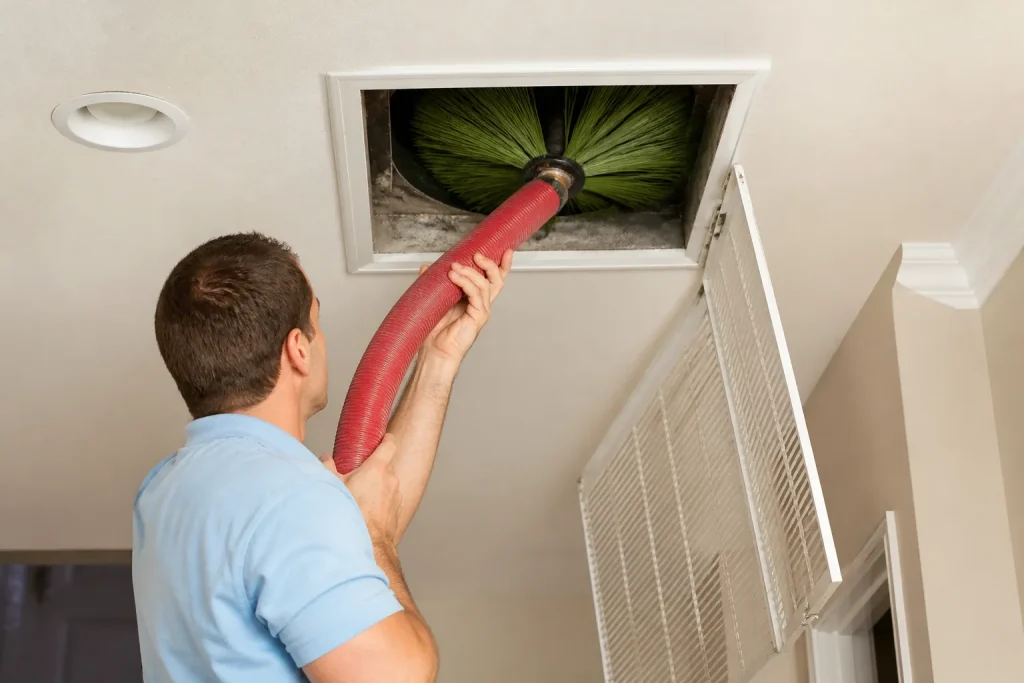
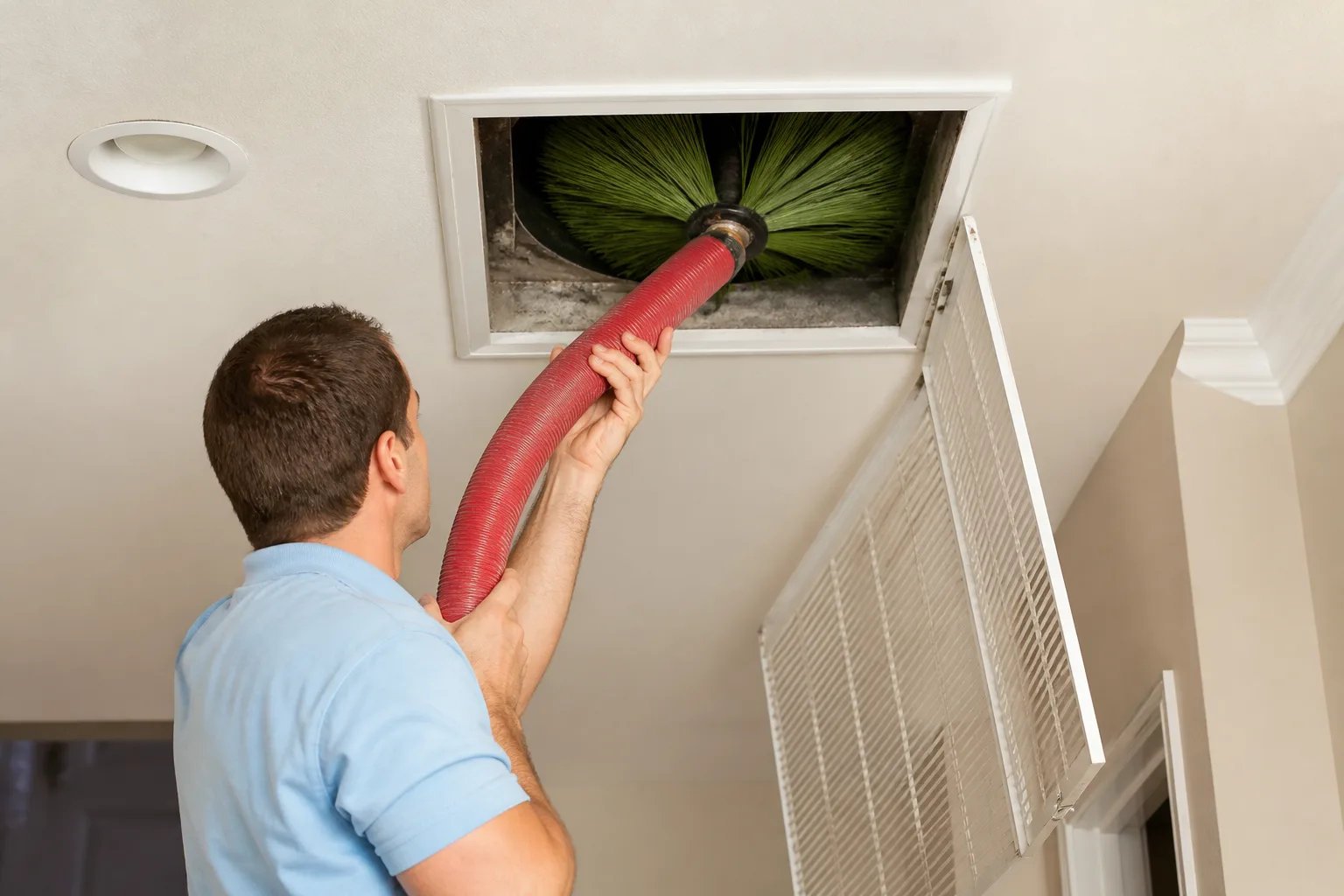
This is also the moment where the full-system approach pays off. A standard vacuum of the visible runs leaves the fine dust in the branches and on the blower. Professional-grade equipment, not shop-vac shortcuts, is what actually clears it. We use Rotobrush and Nikro systems for that reason – they’re the same class of tool trusted by remediation contractors.
When does cleaning alone stop being enough?
Cleaning alone won’t fix the problem when the ductwork itself is damaged or unsealed. If contamination returns within a season of cleaning, if flex duct sections are crushed or torn, or if connections leak at the joints, repair has to come first or the cleaning has no lasting effect.
Watch for these:
- Contamination that returns quickly. If the same rooms get dusty again within months, the system is pulling unfiltered air somewhere.
- Crushed or kinked flex runs. A collapsed section chokes airflow and traps debris. No amount of cleaning restores the run.
- Torn duct insulation. Exposed duct in a humid crawl space sweats and grows contamination.
- Leaking joints. Gaps at the boots, collars and plenum pull in air from cavities that were never meant to feed the system.
That’s the reasoning behind our Duct Repair & Sealing service. Cleaning is only as effective as the duct system is intact, so closing the gaps is part of the job, not a separate upsell. After the system is clean and sealed, an air quality upgrade – an Aprilaire or Honeywell whole-home filter, or a Guardsman sanitizing treatment where microbial growth is a concern – can help keep it that way.
When to call a pro: if you’ve found any of the signs above, or if the five-minute check turned up something you can’t explain, it’s time. Call (888) 881-9239. We answer 24/7. Fast dispatch from 7am to 7pm, Sunday through Friday. Estimates are free, and the price is one flat price per system agreed before work starts, so there are no surprises on the invoice.
Related services in Knoxville: air duct cleaning for the full system, plus dryer vent, HVAC, repair and sealing, and sanitizing when the situation calls for it.
The Bottom Line
The signs worth acting on are the specific ones: debris at the registers, a musty smell tied to the fan, dust that returns too fast, black streaking around supply vents, and the dryer vent that no longer moves air. Each one points at a particular component, and knowing which one saves you from paying for the wrong service. In Knoxville’s humid, pollen-heavy climate, crawl space flex runs and unsealed connections are the usual culprits, and cleaning without repair rarely holds.
We’re Knoxville Air Duct Cleaning Co, and we handle the whole air pathway – ducts, dryer vents, HVAC components, repair and sealing, and air quality – under one company rather than patching one piece. If you’re in Knoxville and need help, Knoxville Air Duct Cleaning Co offers free estimates – call (888) 881-9239. We answer 24/7. Fast dispatch from 7am to 7pm, Sunday through Friday.
Frequently Asked Questions
Every three to five years is a reasonable baseline for most Knoxville homes, but the schedule depends on the house. Homes with pets, recent renovations, crawl space duct runs or a chronically overdue filter need it sooner. The signs themselves are a better guide than the calendar. Call (888) 881-9239 for an exact quote – estimates are free.
Cheap quotes usually price a quick pass over the visible runs and leave the branches, the blower and the coil untouched, sometimes with per-vent pricing that climbs once the technician is on site. We work the other way: one flat price per system, agreed before work starts, with before-and-after photos of your own ducts so you can see what was actually removed. Call (888) 881-9239 for an exact quote – estimates are free.
Ask for before-and-after photos of your own system, taken inside the ducts rather than of the equipment. Anyone who won’t provide them hasn’t given you proof of anything. Our process includes that documentation as standard, along with on-site Abatement Technologies filtration so the debris stays contained. Call (888) 881-9239 for an exact quote – estimates are free.
Recurring contamination almost always means the source wasn’t addressed – typically a damp crawl space run, a leaking joint or a dirty coil. Cleaning the ducts again without finding that source just resets the clock. That’s when Duct Repair & Sealing or HVAC cleaning becomes the real fix. Call (888) 881-9239 for an exact quote – estimates are free.
Written by the team at Knoxville Air Duct Cleaning Co.
Need Air Duct Cleaning Help?
Call Knoxville Air Duct Cleaning Co - the local pro we connect you with is licensed and insured, here with fast help in Knoxville.
(888) 881-9239